Technical Report No. 1BN-TR-1Brown Note Journal
Arranging Popular Songs for an Ensemble of Recorded Flatulence: Methods and Measurements of the Brown Note Pipeline
Abstract
We describe a production pipeline that renders any song supplied as a MIDI file as an instrumental cover in which every note is a single recording of human flatulence, played back faster or slower but never resynthesised, looped or layered. The sound source is a corpus of 230 public-domain recordings, cut into individual events and organised into four playable patches: a melodic singer, a bass, a chordal keyboard and a drum kit. Measuring each patch note by note with a pretrained audio-event classifier shows that the material keeps its identity only in narrow registers. The singer reads as a fart up to C4 (P = 0.42) and not above it (C♯4 0.15; D♯4 and higher, 0.04 or less); the bass reads as a fart only from B1 upward. The pipeline therefore arranges each song around its performers. It selects the melody, bass, harmony, rhythm and drum parts automatically, searches thirteen transpositions for the key the ensemble sings best, re-sings the remaining out-of-range notes a third to a fifth lower on a scale degree, reduces the harmony to a four-lane texture and renders it offline. Lanes are balanced against a reference mix, mastered to −14 LUFS and swept for bird-like artefacts. Across 33 songs (2 h 00 min) the tune sits above all other pitched material for a median 85% of its playing time and plays unaccompanied for a median 5.4%. We also describe a binaural stage rendering in which ten performers are heard from mid-hall, and we report the iterations, including the rejected ones, that led to the approved configuration.
Keywords: music arrangement; sample-based instruments; audio event classification; PANNs; MIDI; transposition; loudness normalisation; binaural rendering; flatulence.
1Introduction
A familiar format in online music is the cover in which a well-known song is played with an unlikely sound source. In the version studied here every note, including every chord tone and every drum hit, must be a recorded fart, and the listener must still recognise the song within its first seconds. The title convention is fixed: “Song but It’s All Farts”.
The format sets four requirements that pull against each other.
- Identity. Each note must be heard as a fart, and not as a pitched instrument that happens to be built from one.
- Recognisability. The tune must be audible, with the right contour and rhythm.
- Clarity. Four parts made of the same material must not mask one another.
- Generality. The method must run unattended on arbitrary MIDI transcriptions of uneven quality.
Identity favours untreated recordings at their natural pitch. Recognisability needs exact pitches across the range a song was written for. Conventional sampling resolves this by resynthesis: pitch-synchronous overlap-add [1], looped sustains and layered velocity zones. Our first two versions did exactly that, and both were heard as synthesisers. The approach that worked inverts the usual order. The instrument is left alone, its usable range is measured, and the song is arranged to fit inside it, as an arranger would do for a real singer.
Figure 1 shows the complete pipeline. A song enters as MIDI, its parts are identified, its key and registers are fitted to the four performers, and a four-lane MIDI file is rendered offline. The rendered lanes are balanced against a reference mix, mastered and checked for artefacts. For the stage version, the same notes are split into ten performers and rendered binaurally.
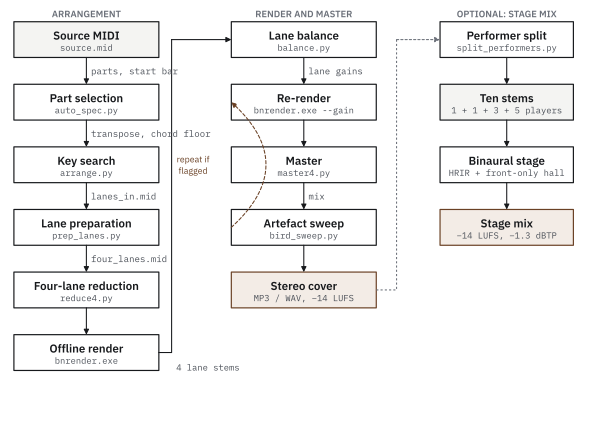
The contributions of this report are: a per-pitch measurement of how far each sampled patch can be played before it stops reading as its source (Section 2); a part-selection method for unlabelled MIDI (Section 4); a constrained key search and re-voicing scheme that keeps the tune inside the measured range (Section 5); objective balance, artefact and quality measures used as release gates (Sections 7 and 8); and a binaural stage mix with a distance model chosen by listening (Section 9).
1.1Development history
The pipeline was developed over two days on one reference song and then a batch of eight. Each version was judged by listening. Table 1 lists every version with the change it made and the result, including the four that were rejected. Two lessons shaped everything after them. First, a sound can score as a fart in isolation and still be heard as a synthesiser once it is resynthesised into a steady, looped note (v1, v2). Second, structural fixes for masking, such as making lanes rest for each other (v7) or carving them into frequency bands (v8), made the result worse than the version they set out to improve. Later changes were therefore made one at a time and measured against the last approved version.
| Version | Change | Measured effect | Outcome |
|---|---|---|---|
| v1 | PSOLA resynthesis at steady pitch, octave layers, sine-reinforced kick | Patch fart-likeness 0.70–0.76 (raw recordings 0.81–0.83); top class ‘Music’ | Rejected: heard as an organ |
| v2 | Zones chosen by fart-likeness; PSOLA with natural pitch follow; looped sustains; 5–6 layers per note | Melody within 50 cents for 35% of notes | Rejected: synthetic, tune not recognisable |
| v3 | One whole recording per note, drift straightened by playback rate; melody two octaves down | 86% of melody notes within 50 cents (sine reference 89%) | Better; too much low end |
| v4 | Four lanes: melody, bass, chords, drums; per-patch high-pass; chords detected per half bar | Energy below 120 Hz: 28% → 11%; melody alone 97% within 50 cents | Accepted as structure |
| v5 | Kit hits auditioned in a groove; bird classes above 0.04 rejected | Drum ‘Crow’ probability 0.46 → 0.05 | Closest reference for later work |
| v6 | 40 synthetic-sounding sources excluded; ride to hi-hat; claps removed | Synthetic-class spikes reduced | Approved |
| v7 | Lane arbitration: lower lanes rest under higher ones | Tune alone ≈ 90% of the time | Rejected: far too sparse |
| v8 | Chords voiced under the tune; ducking; static EQ carving | Note rubs 15.8% → 0%; less fart-like | Rejected: over-corrected |
| v9 | v5 plus intro cut, synthetic sources swapped, ghost snares removed | Reference gaps: bass 9.2, chords 8.8, drums 11.8 dB | Reference mix |
| Take 1 | Eight songs on the v9 recipe; melody notes above C4 folded down an octave | Folded notes fall into the chords | Rejected: high notes inaudible |
| Take 2 | Hi-hat cap of 4 per bar; balance against v9 + 3 dB; clap removed; sweeping cymbal zones replaced | Thriller hats 8 → 4 per bar | Partly accepted |
| Take 3 | Per-song key search; out-of-range notes re-sung on a scale degree | See Section 8 | Approved 16 Nov 2026 |
| Fart-likeness and class probabilities are from the PANNs CNN14 AudioSet model (Section 2.3). ‘Within 50 cents’ compares the rendered melody’s tracked pitch with the score. | |||
2Corpus and sampling
2.1Acquisition and segmentation
All source material comes from Freesound [2] and was retrieved with the licence filter set to Creative Commons 0 [3], so no recording carries an attribution or use restriction; every contributor is nevertheless credited on the Credits page. A total of 397 recordings were downloaded as high-quality previews and resampled to 48 kHz mono.
Each recording was high-passed at 25 Hz and divided into 10 ms frames. A frame is active when its RMS level exceeds both four times the recording’s 10th-percentile level and the peak level minus 34 dB. Active runs separated by less than 150 ms were merged, runs shorter than 80 ms were discarded, and at most fourteen events were kept per recording, each with 12 ms of pre-roll and an 80 ms tail. This produced 877 events. An event was kept when the AudioSet [4] class Fart scored at least 0.15 and the competing classes stayed low (Speech < 0.3, Laughter < 0.2, Music < 0.4, Burping < 0.3, Musical instrument < 0.4). Of the 877 events, 235 were rejected and 642 accepted. The accepted events form the reference set used throughout this report.
2.2A fart-likeness score
Class probabilities alone are a weak guide for long or processed material, because AudioSet labels a clip by its most salient event. We therefore also score a sound by its distance to the reference set in the embedding space of the PANNs CNN14 network [5]. A signal is cut into 2 s windows with a 1 s hop, each window is peak-normalised and embedded, and each embedding is compared with the unit-normalised mean embeddings of the 642 reference events:
where is the set of the ten reference events closest to window . Real fart reels score about 0.81–0.83 on this measure. The v1 patches scored 0.70–0.76 and were classified as Music, which matched the listening verdict.
2.3Four patches
The cover pipeline uses four patches of the Brown Note instrument, built from 196 events taken from 132 recordings. Each patch maps every kept event as a key zone centred on its own median pitch, with its usable length stored alongside. At play time the engine chooses, for each note, the closest-pitched event that is long enough for the note’s duration, and changes its playback rate to reach the target pitch. The event is played whole, from its own attack to its own ending. There are no loops, no crossfades between layers and no pitch-synchronous processing.
Recorded farts drift in pitch, usually downward. Before mapping, each event’s drift is reduced by a time-varying playback rate that leans against its own tracked pitch :
where is the event’s median pitch. The deviation from the median is reduced to 35% of its original size, so the event still bends like a fart but lands close to its note. Texture, noise and the release are untouched.
- Real Fart Singer plays the tune. Its low end is cut at 160 Hz so that it reads as a fart rather than a rumble.
- Real Fart Bass plays the bass line, high-passed at 70 Hz.
- Real Fart Keys plays chords from wetter, messier events; every chord tone is a separate recording. It is high-passed at 220 Hz.
- Real Fart Kit maps General MIDI drum notes [6] to real events. Every hit uses a recorded fart as its main layer, and each candidate was auditioned eight times in a groove and rejected if any bird class scored above 0.04, after one snare round-robin was heard as a crow in v5.
| Patch | Lane | High-pass | Range used | P(Fart) in range | Outside the range |
|---|---|---|---|---|---|
| Real Fart Singer | Melody | 160 Hz | E2–C4 (40–60) | 0.35–0.90 | C♯4 0.15; D♯4 and up ≤ 0.04 |
| Real Fart Bass | Bass | 70 Hz | B1 and up (≥ 35) | 0.52–0.90 | B♭1 0.48; below 0.02–0.29 |
| Real Fart Keys | Chords | 220 Hz | D2–A3 (38–57) | 0.39–0.89 | pruned to zones ≥ 0.3 |
| Real Fart Kit | Drums | per hit | GM 36–51 | – | bird classes ≤ 0.04 in a groove |
Forty events that scored as fart-like in isolation but were sound-designed effects, or thin buzzes classified as Insect, were removed from all patches after v6.
2.4Measuring the usable range
A patch can sound correct at its natural pitch and wrong two semitones higher. To find where each patch stops reading as a fart, we rendered for every MIDI pitch a 2 s phrase of four notes between 0.3 and 1.2 s long through the offline renderer, and recorded the AudioSet probability of the class Fart for the phrase. Zones that scored below 0.1, or whose root lay at or above C4 on the singer, were pruned and the measurement repeated. Figure 2 shows the result after pruning.
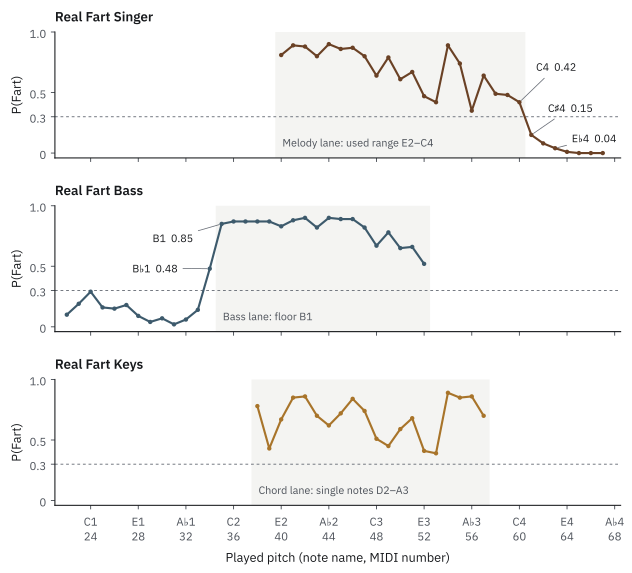
analysis/pitch_curves.json.The singer holds between 0.35 and 0.90 from E2 to B3 and still scores 0.42 at C4. One semitone higher it falls to 0.15, and from D♯4 it scores 0.04 or less, where the classifier hears Music, Speech, Hoot or Meow. The ceiling is sharp: the events that remain in the patch are low, and playing them more than a few semitones faster turns them into squeaks. The bass shows the mirror image. Below B1 the slowed events lose their pulse and read as music, a creaking door or a scrape (0.02–0.29), and from B1 up they score 0.82–0.90. Single notes on the keys stay between 0.39 and 0.89 from D2 to A3.
These curves became the arranger’s constraints. The tune is placed in E2–C4, the bass from B1 upward, and chord tones from E2 up. Everything in Sections 4 and 5 serves to fit a song into those bands without losing it.
3MIDI ingestion
3.1Sources and parsing
Each song enters the pipeline as a Standard MIDI File [7]. The 33 songs in this report come from community transcriptions: 7 were published as ordinary MIDI files and 26 as projects on a browser-based sequencer. Files are read with Mido [8]. Note-on and note-off events are paired first-in, first-out per channel and pitch, so overlapping repeats of one pitch resolve in order, and every note is stored with its track, its channel, its start and end in ticks and its velocity. A part is the set of notes sharing one track and one channel; it is addressed by a selector such as t6c5 (track 6, channel 5). Parts with fewer than eight notes are ignored.
3.2Repairing defective exports
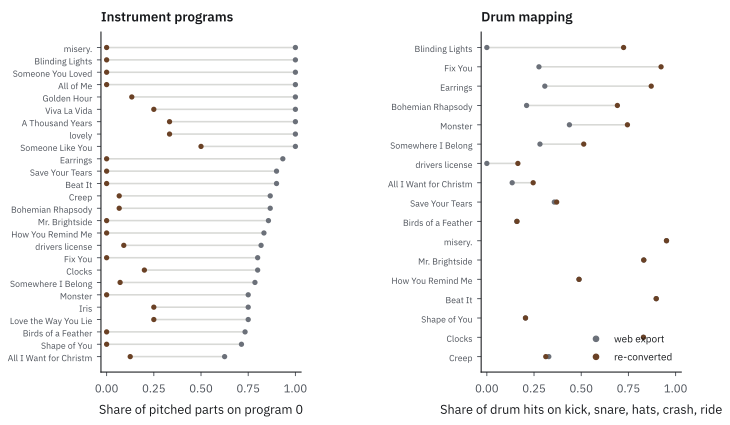
The first batch run on the web-sequencer songs failed in ways that were traced to the sequencer’s own MIDI export rather than to the transcriptions. The export drops every part name, sets most parts to program 0 (Acoustic Grand Piano) whatever they were, writes pitched parts one octave below the sequencer’s display, and in several kits writes drum rows on note numbers that are not the General MIDI equivalents [6]. Part selection depends on exactly the information that is lost: names and programs identify vocals and basses, and register separates the tune from the bass. Table 3 and Figure 3 quantify the damage on all 26 songs.
These songs were therefore converted again from the sequencer’s project data. Part names and General MIDI programs come from the sequencer’s instrument table, drum rows are mapped to General MIDI notes by the names of each kit’s samples (“kick” to 36, “snare” to 38, “closed” to 42, “ride” to 51 and so on), and pitched rows are raised by twelve semitones to match the display.1 After re-conversion every song had named parts, the median share of pitched parts on program 0 fell from 87% to 3%, and the median share of drum hits on the core kit pieces rose from 31% to 69%. Some kits keep hits outside the core pieces after conversion, such as shakers and electronic effects; these have no fart equivalent and are dropped at the reduction stage.
| Property | Web export | Re-converted |
|---|---|---|
| Part names present | 0 of 26 | 26 of 26 |
| Pitched parts on program 0 (median share) | 86.7% | 3.3% |
| Songs with every pitched part on program 0 | 9 | 0 |
| Pitched parts an octave low | 26 of 26 songs | none |
| Drum hits on kick, snare, hats, crash, ride (median, 17 songs) | 30.7% | 69.2% |
| Drum hits outside the GM percussion map (median) | 14.3% | 0.0% |
3.3Normalisation
Three further steps make songs from different sources comparable. Drum variants are merged before anything else (acoustic bass drum 35 to 36, electric snare 40 to 38, pedal hi-hat 44 to 42, crash 2 to crash 1, ride 2 to ride 1, side stick 37 to snare, scratch 30 removed), so doubled kits collapse onto one note. Identical notes in one lane, with the same onset and pitch, are merged and the longer one is kept, so doubled tracks do not stack into flams. Velocities are rescaled per lane, because sources disagree on scale: some are flat at 100 and some peak at 60. With the lane’s 75th-percentile velocity and the level used in the reference arrangement,
for the melody, the bass and the drums respectively. The drums are scaled per drum note, so a quiet hi-hat part is not raised to the level of the kick. Relative dynamics, including ghost notes, survive the scaling.
4Automatic part selection
A transcription does not say which part is the tune. auto_spec.py decides this from the notes alone and writes a specification with one or more selectors for each of five roles: melody, bass, harmony, rhythm (the part whose onsets time the chord stabs) and drums. The rules were derived from eight specifications made by hand for the first batch; on those eight songs the automatic picks matched the hand picks on seven.
4.1Features
Onsets are quantised to a 32nd-note grid. For each part we compute its note count ; its coverage , the share of the song’s bars in which it has notes; its chordal share , the share of onsets that sound more than one pitch class; its mean pitch ; and a melodic score computed on its top line. With the share of steps of at most two semitones, the share of leaps larger than a fifth and the share of repeated notes,
A sung line moves mostly by step, leaps rarely, and does not hammer one note the way a riff or a strummed part does. The tune score of a part combines this with its texture, register and size:
where when and 0.4 otherwise, is 1.5 for a part named like a voice or lead, 1.3 for a choir or voice program and 1 otherwise, and is the number of distinct onsets. Parts with coverage below 0.2 score zero.
4.2Roles
Drums are the channel-10 parts that play through at least a quarter of the song, at most three, each with at least 15% of the largest one’s notes. Doubled kits are merged later by the deduplication in Section 3.3.
Bass is chosen among parts with a bass program or name, or a low () and mostly single-note line, with coverage of at least 0.25. Of the parts that carry the low end through most of the song, the lowest is preferred when it sits at least three semitones under the busiest. When a song has no bass part at all, as in piano arrangements, the bass is taken from the left hand of the part under the tune that plays through most of the song: per beat, the lowest note that starts in it, drawn only from that part’s lowest 35% of pitches, held until the next bass note. 11 of the 33 songs use this left-hand bass.
Melody. When a file carries at least twenty lyric events, the part whose onsets land on the syllables (within 0.13 beats) is the tune, if it matches at least half of them. Otherwise the part with the highest tune score is taken. A second or third part joins it only when it is the same kind of line playing where the first rests: same instrument family, at least 55% of the first part’s quality, less than 30% overlap in time, less than half its notes in common, a mean pitch within seven semitones, and a chordal share no more than 0.15 above the first part’s. The last condition was added after a chord part joined the tune of Birds of a Feather: in the broken exports every part shared program 0, so the family test alone let it through. When the chosen tune part is itself chordal, the top note of each onset is taken as the tune; 6 songs use this.
Harmony is up to three of the fullest remaining parts in the middle register, ranked by for parts with . Parts that copy the tune or each other (more than 60% of notes shared) take one slot.
Rhythm. Chords in the cover sound only on the onsets of the rhythm part, so it must play through the song. It is the harmony part with the most onsets weighted by ; when that part covers less than half of the song, the fullest harmony part with coverage of at least 0.7 joins it. This rule was added after the first version of drivers license took its stabs from a synthesiser present in 44% of bars and left the tune alone for half the song.
Start bar. Covers begin where the tune enters, so the song is recognisable from its first second. The start is the first bar from which the tune plays in at least six of the next eight bars; an introductory statement followed by a long rest does not count.
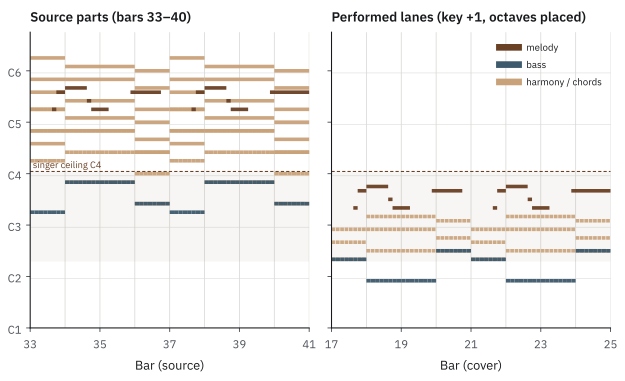
Figure 4 shows the features and the resulting roles for Clocks.
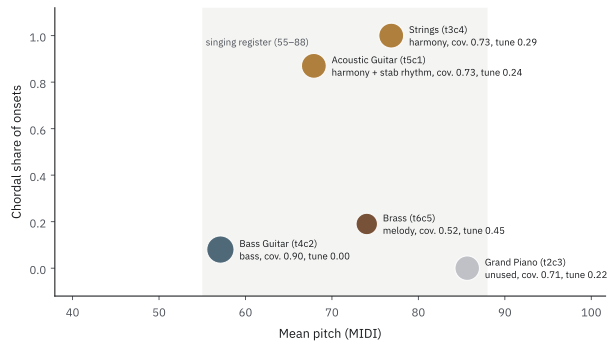
auto_spec.py, and each label gives coverage and tune score . The highly chordal piano riff in the top register is left out because it duplicates the harmony and its register would sit above the tune.5Arranging for the performers
Sections 2.3–2.4 fix the ranges; this section fits each song into them. The work is split between prep_lanes.py, which places octaves, transposes, re-sings and keeps the bass under the tune; arrange.py, which searches for the key; and reduce4.py, which reduces the harmony and drums to the four lanes.
5.1Octave placement
Melody and bass are first moved by whole octaves, in the original key, so their median pitches sit where the performers sound best. For a lane with median pitch and target ,
The melody target comes from the reference arrangement, whose tune had a median of 53. The bass octave is chosen after the transposition of Section 5.2, around D2. Bass notes still under B1 are raised by octaves; octave jumps are normal in a bass line, and nothing in the library reads as a fart below B1. The tune itself is never folded. Across the 33 covers the performed melody has a median pitch of E3 (52) and the bass E2 (40).
5.2Choosing the key the farts sing best
A tune that spans more than the singer’s twenty semitones cannot be placed by octaves alone, and the singer’s quality is uneven inside its range (Figure 2). arrange.py therefore treats the key as a free parameter, as a singer would. It tries every transposition from −9 to +3 semitones. For downward moves it also tries letting the chord register follow the key, with the chord floor at instead of 40 (never below 36). Each candidate is run through the real prep_lanes.py and reduce4.py and scored on the resulting lanes:
Here is the duration-weighted mean of the singer’s per-pitch fart probability over the tune’s notes (0.3 below E2, where the 160 Hz high-pass removes the fundamental); is the share of tune notes not covered by an equal or higher chord tone; is the share of tune notes that still lie above C4 and must be re-sung; and are the duration-weighted bass and keys curves; is the share of bass notes at or above a sounding tune note; and the last term prefers small moves. A candidate is admissible only if at most 2% of the tune lies below E2, at most 5% of the bass rises over the tune, and at most 10% of the tune must be re-sung. The best admissible candidate is written to the song’s specification; if none is admissible the best overall is used.
| Key move | Chord floor | F | T | R | B | K | Below E2 | Within limits | S |
|---|---|---|---|---|---|---|---|---|---|
| +1 | 40 | 0.656 | 0.848 | 0.020 | 0.803 | 0.691 | 0.000 | yes | 1.504 |
| +2 | 40 | 0.608 | 0.848 | 0.020 | 0.821 | 0.671 | 0.000 | yes | 1.447 |
| +3 | 40 | 0.644 | 0.892 | 0.067 | 0.822 | 0.651 | 0.000 | yes | 1.426 |
| −4 | 36 | 0.742 | 0.824 | 0.000 | 0.749 | 0.740 | 0.088 | no | 1.558 |
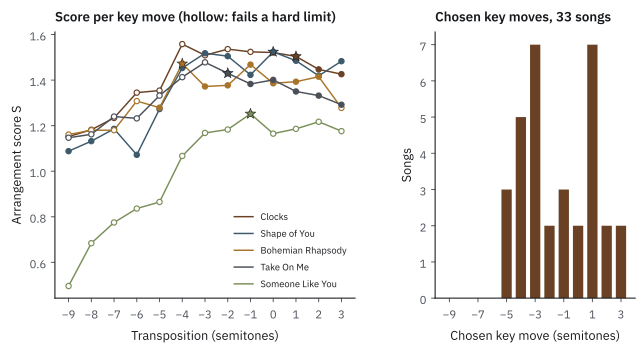
arrange.py; hollow markers break a hard limit and stars mark the key used. No candidate for Someone Like You meets every limit, so its best overall score is used. Right: the chosen key moves for all 33 songs.The chosen moves range from −5 to +3 semitones. 20 of the 33 songs move down, 11 move up and 2 keep their key. The search mostly trades the singer’s strong region (E2–B2, probability 0.8–0.9) against the cost of notes above C4.
5.3Re-singing notes above C4
After the transposition a few tune notes may still lie above C4. In the first batch these were folded down an octave, which buried them inside the chords and made them hard to hear. They are now re-sung the way a singer adapts a line that lies too high: each note above the ceiling is lowered by the smallest of a minor third, major third, fourth, fifth, minor sixth or major sixth that lands on a note of the song’s scale at or below C4. The scale is taken as the seven pitch classes that sound longest across melody and harmony. Only if none of these works is the note folded by octaves. The line keeps its rhythm and stays above the chords, and its contour changes only locally.
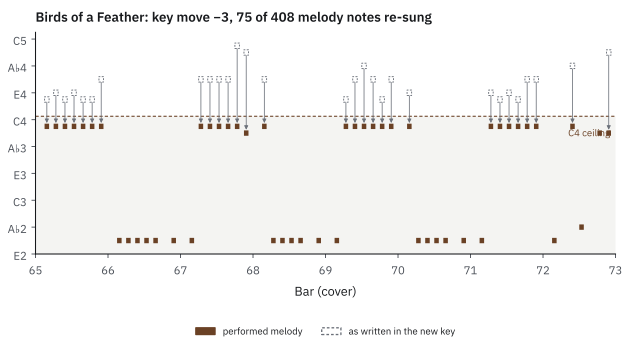
prep_lanes.py twice, with and without the C4 ceiling.Across all covers 363 of 12,304 performed melody notes (3.0%) are re-sung.
5.4Keeping the bass under the tune
Because the tune now sits low, a bass line in its original register can reach it. Any bass note at or above a tune note sounding at the same time drops an octave, as long as it stays at or above C1. This moved 1,076 bass notes across the 33 songs. The rule exists because the chord lane and the bass are made of the same material as the tune; once the bass crosses the tune, the ear follows the higher fart.
5.5Reduction to four lanes
The cover keeps the four-channel layout of an 8-bit game console [9]: one melody, one bass, one chord lane and one drum lane. This was the structure that first made the material legible (v4 in Table 1). reduce4.py builds it in four steps.
Monophony. Melody and bass are made monophonic. A new note cuts the previous one; notes starting together keep the highest (melody) or the first; notes shorter than a 64th of a beat are dropped.
Key. The key is estimated with the Krumhansl–Schmuckler method [10, 11]: the duration-weighted pitch-class histogram of harmony, bass and melody is correlated with the 24 rotated major and minor profiles , and the best pair is kept:
Chords. For each half bar, a pitch-class histogram is built from the harmony parts and the bass (the bass weighted 1.6) and matched against the 24 major and minor triads. A triad with root scores
with a further bonus of for the minor reading of a window that has no third (a power chord) in a minor key. In minor keys only the dominant gets the raised seventh; an earlier version added it to the whole scale, which made A minor “diatonic” in C♯ minor and produced wrong chords on power-chord windows. A window that differs from identical neighbours on both sides takes their chord. The chord is voiced as a close triad from the chord floor upward and played as a stab on every onset of the rhythm part, quantised to eighth notes and lasting 85% of the time to the next onset, at most one beat. The reduction also prints a chord chart, which was used to check each song against its original by ear. The opening of the chart for Clocks:
  bar   1: E         Bm        Bm        F#m       E         Bm        Bm        F#m
  bar   9: E         Bm        Bm        F#m       E         Bm        Bm        F#m
Drums. Only kick, snare, hi-hats, crash and ride are kept. Claps are removed: in the kit they are three stacked farts whose spectral flatness (0.43, against below 0.01 for the snares) reads as a hiss. Hits with velocity below 60 are dropped as ghost notes. Closed hi-hats are capped at four per bar, keeping the off-beat eighths first, then the beats, then sixteenths; one source had sixteenth-note hats at eight per bar against 2.4 in the reference, and the melody was lost under them. Across all songs the cap removed 4,763 of 9,593 closed hats.
6Rendering
The four-lane file is rendered by bnrender.exe, an offline MIDI-to-WAV renderer that runs the same engine as the Brown Note VST2 instrument [12]; the two were checked to produce bit-identical output. The patch for each lane is named in brackets in its track name, for example Melody [Real Fart Singer]. The renderer passes each note’s length to the engine, which chooses the closest-pitched event long enough to cover it (Section 2.3) and plays it at rate
where is the note and the event’s own median pitch. Output is 48 kHz, one stem per lane, with per-lane gains in decibels (the melody at +7 dB, chords and drums at −4 dB before balancing). The sum of the stems exceeds full scale, as expected before mastering: Clocks peaks at +5.2 dBFS at this stage. Stems are therefore kept in floating point until the master.
The VST2 instrument exposes the same engine in a host, with about forty patches and controls for volume, envelope, tone, resonance, velocity response, saturation, pitch wobble, a tiled-room reverb and its size, tuning and glide. None of these controls is used by the cover pipeline, which renders every patch at its designed settings.

7Balance, mastering and artefact control
7.1Lane balance against a reference
All four lanes share one timbre, so the tune can only stand out by level and register. balance.py measures how far each accompaniment lane sits under the melody while the melody plays. Each stem is band-passed to 150 Hz–5 kHz, the range the ear uses to follow a line, and its RMS level is taken in 100 ms frames. Over the frames in which the melody is within 30 dB of its maximum, the gap to lane is
The targets are the gaps measured in the approved reference mix (Rolling in the Deep, v9: bass 9.2, chords 8.8, drums 11.8 dB) plus 3 dB, added after the first batch was reported as hard to follow: 12.2, 11.8 and 14.8 dB. After the first render, any lane closer to the melody than its target is turned down by the difference and the song is rendered again. Lanes are never turned up. Figure 9 shows the gaps measured at the first render: the bass was turned down in 26 of 33 songs, the chords in 5 of 33 and the drums in 13 of 24.
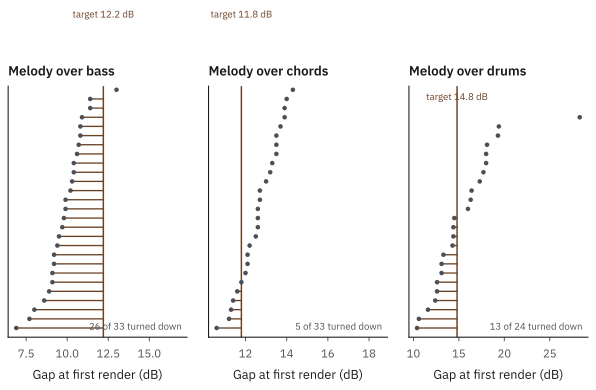
Two structural alternatives were tried before this rule and rejected. Making lower lanes rest under higher ones (v7) left the tune alone about 90% of the time. Carving the lanes into separate frequency bands (v8: chords above 600 Hz, bass below 300 Hz) reduced measured masking but made the mix less fart-like and turned the bass into a drone. Level alone, measured against a mix that was already approved, keeps the texture intact.
7.2Mastering
master4.py sums the four stems, high-passes the sum at 38 Hz to remove rumble below the farts’ range, and applies a slow glue compressor (2:1 above −20 dBFS on a 50 ms RMS envelope). Integrated loudness is measured according to ITU-R BS.1770 [13] and the mix is scaled to −14 LUFS, the level used by the major streaming services and close to the EBU R 128 practice for programme normalisation [14]. A peak limiter with instant attack and 80 ms release then holds the sample peaks at −1 dBFS. Before mastering the covers measured between -19.1 and -14.1 LUFS (median -16.2); the limiter’s largest gain reduction had a median of 2.9 dB and a maximum of 6.7 dB.
The limiter works on sample peaks, not true peaks. Measured with four-times oversampling, the stereo master of Clocks reaches +0.06 dBTP, so the stereo masters can clip slightly after lossy encoding. The stage mix in Section 9 uses an oversampled look-ahead limiter and does not have this problem.2
7.3Bird-like artefacts
Short, nasal farts repeated on a beat can be heard as a bird. In v5 one snare round-robin was heard as a crow, and the classifier agreed (Crow 0.46). Kit samples are now screened (Section 2.3), but birds can still appear when two lanes combine. bird_sweep.py scans every finished master in 1 s windows with a 0.25 s hop and flags windows in which any bird class of AudioSet (crow, caw, squawk, duck, goose, owl, chicken, pigeon, gull and related classes, excluding Crowd) exceeds 0.25. Snare hits inside flagged windows are removed from the four-lane file and the song is rendered and mastered again, repeating until no window is flagged. A global rule that removed every snare coinciding with a melody onset was tried first; it removed two thirds of the snares, because sung phrases often start on the backbeat, and was dropped.
In the 33 covers one song was flagged: Golden Hour, with Bird at 0.33 and 0.28 around 52 s and 0.54 at 124.5 s. The song has no drums, so there were no snares to remove and the flags remain. This is a limitation of the current sweep, which only acts on the snare.
8Quality metrics
Two measures summarise whether the tune can be followed. Both are computed on the performed four-lane MIDI in 10 ms frames over the set of frames in which the tune sounds. With the tune’s pitch and the highest bass or chord pitch in frame (undefined when neither sounds), the share of time the tune sits on top is
and the share of time it plays alone is
Drums are not pitched and are ignored. A high means the tune is the highest voice, which listeners tend to hear as the melody [15, 16]. A low means the tune is accompanied: v7, in which lanes rested for each other, reached roughly 90% and was rejected as far too sparse. The reference arrangement measures 84.3% and 11.1% on the same definitions.
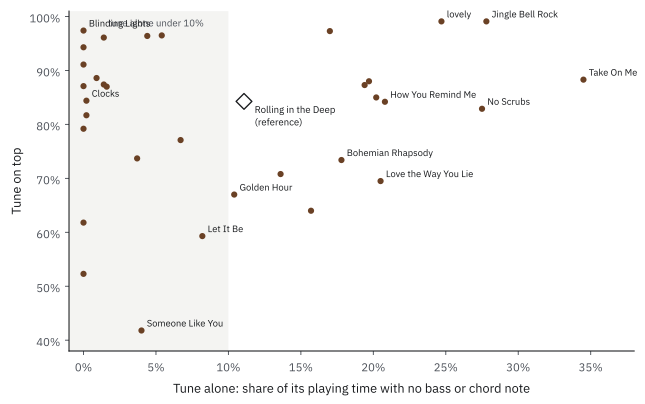
Across the 33 covers the median is 85.0% and the median is 5.4%, both on the right side of the reference. The spread is wide. 15 songs have the tune on top less often than the reference; the lowest is Someone Like You at 41.8%, a piano arrangement in which the left-hand bass and the chords sit close under a low tune. 14 songs exceed 10% alone, led by Take On Me at 34.5%, where the synthesiser riff that times the stabs rests while the verse is sung. Neither measure was used as a hard gate in this batch; the songs were released on listening, and both measures are reported here so that later batches can be compared. Table 5 gives the full results.
| Song | Key | Re-sung | Melody notes | Melody range | T % | A % | Pre-master LUFS | Limiter dB |
|---|---|---|---|---|---|---|---|---|
| A Thousand Years | −3 | 3 | 70 | D2–C4 | 61.8 | 0.0 | -17.8 | -6.7 |
| All I Want for Christmas Is You | −5 | 0 | 89 | A2–B3 | 91.1 | 0.0 | -17.1 | -4.8 |
| All of Me | +1 | 0 | 869 | A1–B3 | 52.3 | 0.0 | -15.9 | -1.6 |
| Beat It | −4 | 43 | 646 | F♯1–C4 | 87.3 | 19.4 | -16.3 | -3.4 |
| Birds of a Feather | −3 | 85 | 408 | F♯2–B3 | 64.0 | 15.7 | -16.7 | -2.5 |
| Blinding Lights | +1 | 0 | 190 | C♯3–B3 | 97.4 | 0.0 | -17.2 | -2.4 |
| Bohemian Rhapsody | −4 | 1 | 403 | C♯2–B3 | 73.4 | 17.8 | -18.1 | -5.7 |
| Clocks | +1 | 6 | 250 | E2–B3 | 84.4 | 0.2 | -16.4 | -3.6 |
| Creep | −3 | 43 | 84 | E2–C4 | 88.0 | 19.7 | -19.1 | -6.1 |
| Dancing Queen | −3 | 0 | 275 | F♯2–B3 | 97.3 | 17.0 | -16.4 | -4.1 |
| drivers license | −3 | 1 | 448 | D2–C4 | 81.7 | 0.2 | -15.3 | -2.7 |
| Earrings | +1 | 0 | 145 | B2–A3 | 96.4 | 4.4 | -16.2 | -2.9 |
| Fix You | −4 | 0 | 663 | B1–B3 | 87.0 | 1.6 | -14.2 | -1.2 |
| Golden Hour | −2 | 56 | 622 | D2–B3 | 67.0 | 10.4 | -14.1 | -1.5 |
| How You Remind Me | +1 | 0 | 439 | F♯2–B3 | 84.2 | 20.8 | -15.2 | -2.3 |
| Iris | +2 | 0 | 253 | E2–B3 | 79.2 | 0.0 | -16.6 | -3.9 |
| Jingle Bell Rock | −3 | 0 | 284 | B2–B3 | 99.1 | 27.8 | -15.8 | -2.4 |
| Last Christmas | +2 | 8 | 365 | F♯1–B3 | 77.1 | 6.7 | -16.2 | -4.2 |
| Let It Be | −3 | 0 | 350 | C♯2–A3 | 59.3 | 8.2 | -16.0 | -3.3 |
| Love the Way You Lie | −4 | 0 | 735 | E♭2–B♭3 | 69.5 | 20.5 | -15.1 | -1.7 |
| lovely | −1 | 0 | 96 | E♭3–A♭3 | 99.1 | 24.7 | -17.3 | -3.9 |
| misery | −4 | 20 | 215 | B2–B3 | 94.3 | 0.0 | -17.4 | -4.5 |
| Mockingbird | ±0 | 0 | 131 | A1–B3 | 87.1 | 0.0 | -17.2 | -4.1 |
| Monster | −5 | 0 | 458 | F2–C4 | 73.7 | 3.7 | -14.3 | -0.3 |
| Mr. Brightside | +3 | 0 | 362 | B2–B3 | 96.1 | 1.4 | -15.1 | -2.8 |
| No Scrubs | +3 | 8 | 395 | A2–B3 | 82.9 | 27.5 | -16.3 | -3.6 |
| Save Your Tears | −5 | 65 | 328 | B1–C4 | 87.4 | 1.4 | -17.0 | -3.7 |
| Shape of You | ±0 | 5 | 804 | A♭2–B3 | 85.0 | 20.2 | -14.8 | -0.7 |
| Someone Like You | −1 | 4 | 752 | B1–B3 | 41.8 | 4.0 | -15.5 | -2.3 |
| Someone You Loved | +1 | 0 | 372 | E2–A3 | 70.8 | 13.6 | -14.7 | -2.3 |
| Somewhere I Belong | +1 | 0 | 300 | A2–B3 | 96.5 | 5.4 | -15.2 | -2.8 |
| Take On Me | −2 | 4 | 215 | G1–B3 | 88.3 | 34.5 | -16.3 | -3.4 |
| Viva La Vida | −1 | 11 | 288 | A2–C4 | 88.6 | 0.9 | -15.9 | -2.8 |
| Reference (Rolling in the Deep, same measures): T 84.3%, A 11.1%. | ||||||||
9Spatialisation: the orchestra on stage
The stereo covers present the four lanes as a flat mix. The stage version presents them as what they nominally are: ten performers on a theatre stage, each bent over with their back to the audience. It was made for Clocks.
9.1Splitting the performers
split_performers.py reads the exact four-lane file of the approved render and writes one MIDI file per performer. The melody and the bass are one performer each. The chord lane is split into voices by rank: at each stab the lowest note goes to the low player, the next to the middle player and the highest to the top player. The drum lane is split by instrument into kick, snare, hi-hat, ride and crash. Each performer is rendered alone through bnrender.exe with the lane gains that the flat mix used after balancing, as 32-bit float, and padded or trimmed to the flat stems’ length. Summed per lane, the performers reproduce the flat stems, which the tool checks for every lane.
9.2Binaural rendering
Each performer is rendered separately by an in-house binaural engine as a point source at a fixed position, through a head-related impulse response for the direct path [17], with frequency-dependent air absorption [18] and a send to one shared hall reverb with the same random seed for every performer. Rendering one performer at a time means the ten results add up exactly to the mix, so each performer’s share can be measured. The reverb input is high-passed at 180 Hz to keep low-frequency build-up out of the hall, and the send level grows with distance:
where is the performer’s send (0.05 for the kick to 0.16 for the chords) and the distance in metres. The factor 0.7 keeps the hall as dry as the first version.
9.3Choosing the seat
The first version (v1) seated the listener in row 3, centred, with the front line at 6–6.5 m and the drum riser at 9.5 m. It was rejected on first listening; the producer’s note read “sounds like I am in the middle of the stage”. Two causes were found. The engine returns reverb from four directions around the head, at 50°, 130°, 230° and 310°, two of them behind the listener: right for an outdoor scene, wrong for a theatre seat, where the hall sound arrives from the stage house in front and the side walls. And the full-range tone match to the flat mix had flattened the high-frequency cues that place a source in front [17].
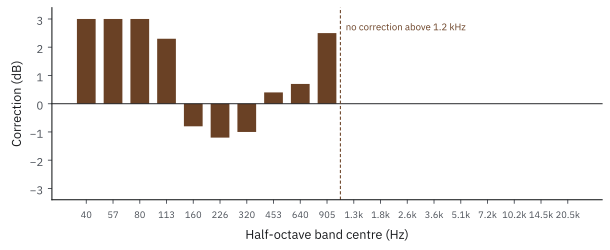
The second version (v2) moved the listener to mid-hall: front line about 11 m away, drum riser about 14.5 m and 0.5 m higher, and the whole ensemble within ±20° (Figure 11, Table 6). A performer bent over places their source about 0.9 m above the stage floor, 0.75 m above a seated ear. Reverb returns were restricted to the front: ±18° at 12° elevation and ±55° at 18°. The tone match to the flat mix was limited to the body of the sound, below 1.2 kHz and at most ±3 dB per half-octave band (Figure 12), so the pinna cues above it are left alone. Air absorption was switched on.
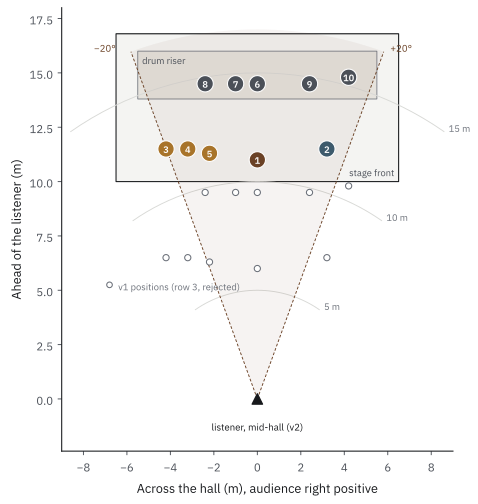
| Performer | Notes | v2 dist. (m) | v2 az. (°) | v2 elev. (°) | Reverb send | Level (dB) | v1 dist. (m) | v1 az. (°) |
|---|---|---|---|---|---|---|---|---|
| 1. Singer (the tune) | 250 | 11.0 | 0.0 | 3.9 | 0.08 | +0.75 | 6.0 | 0.0 |
| 2. Bass | 1,051 | 12.0 | +15.5 | 3.6 | 0.14 | +0.00 | 7.3 | +26.2 |
| 3. Chords, low note | 900 | 12.3 | -20.1 | 3.5 | 0.16 | +0.00 | 7.8 | -32.9 |
| 4. Chords, middle note | 900 | 12.0 | -15.5 | 3.6 | 0.16 | +0.00 | 7.3 | -26.2 |
| 5. Chords, top note | 900 | 11.5 | -11.0 | 3.7 | 0.16 | +0.00 | 6.7 | -19.2 |
| 6. Drums, kick | 642 | 14.6 | 0.0 | 4.9 | 0.05 | -0.80 | 9.6 | 0.0 |
| 7. Drums, snare | 384 | 14.6 | -3.9 | 4.9 | 0.12 | -0.80 | 9.6 | -6.0 |
| 8. Drums, hi-hat | 192 | 14.8 | -9.4 | 4.9 | 0.10 | -0.80 | 9.9 | -14.2 |
| 9. Drums, ride | 536 | 14.8 | +9.4 | 4.9 | 0.10 | -0.80 | 9.9 | +14.2 |
| 10. Drums, crash | 108 | 15.5 | +15.8 | 7.0 | 0.14 | -0.80 | 10.8 | +23.2 |
9.4Tune margin and master
Spreading the ensemble across a stage could make the tune harder to pick out, which would defeat the purpose. The tune margin, the median over 400 ms frames of the K-weighted level of the singer minus that of everyone else, was required to be at least as large as in the flat mix. Raising the singer by 0.75 dB met it: 8.1 dB median and 4.2 dB at the 20th percentile, against 7.5 and 4.1 dB for the flat mix. The binaural path’s latency of 77 samples was removed so the stage mix is sample-aligned with the stereo cover. The master uses a look-ahead limiter on four-times oversampled peaks with a ceiling of −1 dBTP and reaches -14.02 LUFS integrated and -1.3 dBTP. The limiter reduced gain by more than 1 dB for 11.44% of the song and by more than 3 dB for 1.325%, with a maximum of 6.0 dB. Version 2 was approved. Stage mixes for the other songs have not been made.
10Results and limitations
The pipeline produced 33 covers, 2 h 00 min of music, from MIDI transcriptions of uneven quality, without hand editing of any song. Every note of every cover is one recording of a fart: 12,304 melody notes, 13,412 bass notes, 17,446 chord stabs of three recordings each and 19,934 drum hits. The tune stays inside the singer’s measured range in every song, with 3.0% of its notes re-sung to get there, and it sits on top for a median 85.0% of its playing time. The configuration was approved by listening on 16 November 2026, after nine versions of the reference arrangement and three takes of the first batch.
The main finding is methodological. Every attempt to make the material behave like a conventional sampled instrument, by resynthesis, loops, layers, lanes that rest for each other or frequency carving, made it sound less like what it is. What worked was to measure the instrument and arrange for it: keep each recording whole, find the range in which it keeps its identity, and move the song into that range.
The work has clear limitations.
- A classifier stands in for a listener. Fart-likeness is measured with an AudioSet model. It agreed with listening on every case reported here, but it was trained on a different task, and its probability is not a perceptual scale.3
- The range curves come from short phrases. The per-pitch measurements use 2 s phrases of four notes. Long held notes and fast runs may behave differently at the edges of the range.
- The weights are set by hand. The coefficients of Equation (7) were set on a handful of songs. For Someone Like You no candidate key met every hard limit.
- Accompaniment metrics vary widely. 14 songs leave the tune alone more than 10% of the time and 15 put it on top less often than the reference. Both trace back to the source arrangements, which the pipeline follows rather than rewrites.
- Artefact control only acts on the snare. One flagged song has no snare to remove.
- The stereo masters use a sample-peak limiter and can exceed 0 dBTP slightly.
- Transcriptions set the ceiling. Eight songs were left out of this batch because every available transcription was partial or put the tune against the chords, and nine more had no usable transcription at all.
Natural next steps are a listening test to calibrate the classifier against listeners, the oversampled limiter for the stereo masters, an artefact sweep that can also thin the chord lane, and stage mixes for the remaining songs.
Notes
- In the sequencer’s project format a pitched row’s type 24 is displayed as C2, so the export’s C1 for the same note is an octave low. ↩
- The fix is to replace the sample-peak limiter in
master4.pywith the oversampled one from the stage mix. It was left out of this release so that the approved masters stay bit-identical. ↩ - In particular, AudioSet probabilities are not calibrated across classes. A value of 0.42 at C4 means the patch is still recognised as the class, not that 42% of listeners would agree. ↩
References
- E. Moulines and F. Charpentier, “Pitch-synchronous waveform processing techniques for text-to-speech synthesis using diphones,” Speech Communication, vol. 9, no. 5–6, pp. 453–467, 1990.
- F. Font, G. Roma and X. Serra, “Freesound technical demo,” in Proc. 21st ACM International Conference on Multimedia, 2013, pp. 411–412.
- Creative Commons, “CC0 1.0 Universal Public Domain Dedication,” 2009. [Online]. Available: https://creativecommons.org/publicdomain/zero/1.0/
- J. F. Gemmeke, D. P. W. Ellis, D. Freedman, A. Jansen, W. Lawrence, R. C. Moore, M. Plakal and M. Ritter, “Audio Set: An ontology and human-labeled dataset for audio events,” in Proc. IEEE ICASSP, 2017, pp. 776–780.
- Q. Kong, Y. Cao, T. Iqbal, Y. Wang, W. Wang and M. D. Plumbley, “PANNs: Large-scale pretrained audio neural networks for audio pattern recognition,” IEEE/ACM Transactions on Audio, Speech, and Language Processing, vol. 28, pp. 2880–2894, 2020.
- MIDI Manufacturers Association, General MIDI System Level 1, 1991.
- MIDI Manufacturers Association, Standard MIDI Files 1.0, RP-001, 1996.
- O. M. Bjørndalen et al., Mido: MIDI objects for Python, software, version 1.3. [Online]. Available: https://github.com/mido/mido
- Nintendo Co., Ltd., Game Boy Programming Manual, version 1.1, 1999 (sound controller, four channels).
- C. L. Krumhansl, Cognitive Foundations of Musical Pitch. New York: Oxford University Press, 1990.
- D. Temperley, “What’s key for key? The Krumhansl–Schmuckler key-finding algorithm reconsidered,” Music Perception, vol. 17, no. 1, pp. 65–100, 1999.
- Steinberg Media Technologies, VST 2.4 Plug-in SDK, Hamburg, 2006.
- International Telecommunication Union, Recommendation ITU-R BS.1770-4: Algorithms to measure audio programme loudness and true-peak audio level, Geneva, 2015.
- European Broadcasting Union, EBU R 128: Loudness normalisation and permitted maximum level of audio signals, Geneva, 2020.
- D. Huron, “Tone and voice: A derivation of the rules of voice-leading from perceptual principles,” Music Perception, vol. 19, no. 1, pp. 1–64, 2001.
- A. S. Bregman, Auditory Scene Analysis: The Perceptual Organization of Sound. Cambridge, MA: MIT Press, 1990.
- J. Blauert, Spatial Hearing: The Psychophysics of Human Sound Localization, rev. ed. Cambridge, MA: MIT Press, 1997.
- International Organization for Standardization, ISO 9613-1: Acoustics — Attenuation of sound during propagation outdoors — Part 1: Calculation of the absorption of sound by the atmosphere, 1993.